Visual Ensemble Analysis with Deep Learning Prediction for Studying the Effect of Tissue Properties on Radiofrequency Ablation
Jun 30, 2024·,,,,, ,,
,,
Raneigh Sabbagh Gol
Marina Evers
Karl Heimes
Tim Gerrits
Sandeep Gyawali
David Sinden
Tobias Preusser
Lars Linsen
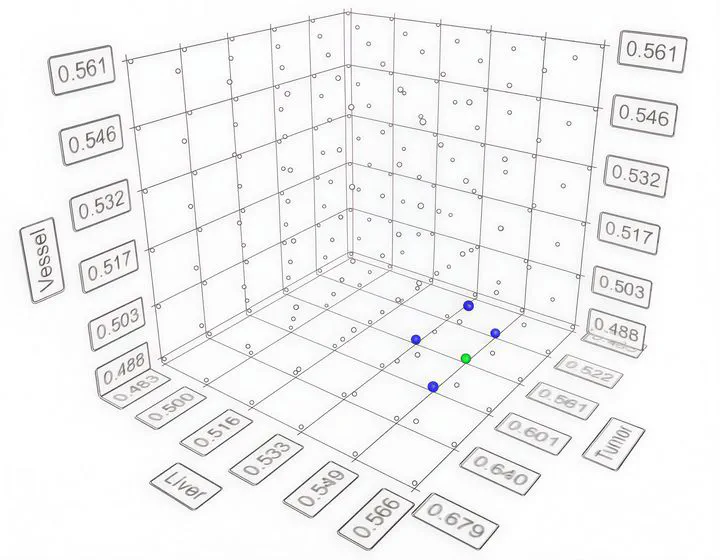 Parameter space
Abstract
Radiofrequency ablation refers to a minimally invasive tumor ablation treatment using radiofrequency electromagnetic waves. A needle is placed inside the tumor, and an electrical current is applied, which is absorbed heating the tissue to burn the tumor. For treatment planning, the heat propagation is simulated, but the treatment volumes are significantly affected by the tissue properties, which vary between different patients, based upon both the vasculature and levels of fat and water content. Undertreatment can lead to tumor recurrence, while over treatment damages healthy tissue. We propose to study the effect of tissue properties on the ablation based on an interactive visual analysis of simulation ensembles, where the tissue properties form the parameter space of the ensemble. The proposed Tissue Property Analysis Tool (TPAT) uses 2D and 3D spatial visualizations for comparative analysis of simulation outcomes for different parameter settings. A 3D parameter-space visualization allows for the analysis of the effect on the ablation result when modifying a selected parameter for the three involved tissues (tumor, liver and vessels). During the analysis, any parameter setting shall be accessible. When no simulation outcome has been generated for a selected parameter setting, we deploy a deep learning-based surrogate model to predict an ablation outcome. We discuss our approach with domain experts for developing simulation models and demonstrate the usefulness of our approach for analyzing the effect of tissue properties on radiofrequency ablation of liver tumors.
Type
Publication
Computer Graphics Forum